Feb 25, 2016 |
Was one of your New Year’s resolutions to save more money? Yeah. It ranks up there with
- Eat healthy
- Exercise more
- Improve life
It’s hard, though, isn’t it?
You know what? You’re not alone. When I started sharing about my bad credit experiences, I was overwhelmed with supportive and encouraging comments. So many of you were or are in the same boat, and didn’t know it.
We think we’re alone and headed for a comedy of errors like Gilligan’s Island.

To Sea in a Storm by Yourself? It ain’t so.
But the truth is, while our individual situations are unique, we have the opportunity to throw life rafts to each other just with words of encouragement and “been there, done that” talk.
There’s a lot in life that can make us feel bad about ourselves. Keeping up with the Joneses is, in my opinion, one of the worst. Which Jones are we talking about? The one who’s a family friend or the one who lives on the other side of town, you know, the right side of the tracks?
When I have money troubles, everything else is amplified. I can’t buy medicine because I can’t afford the doctor visit in order to get the prescription. Or I feel guilty for munching at McDonald’s but in reality I was hungry and didn’t have time to get to the store on my lunch hour. The phone rings constantly, but it’s almost always “Call from Unavailable.”
It wears a person down, doesn’t it? And when you’re worn down, you can’t always see the solution, if there is one.

Cloud of Negativity
Recently, I made a self-discovery. I told myself, “I’m tired of worrying.” Sure, easier said than done, and yes I do still have those moments.
But I started smiling more and stressing less. I gave myself permission to not feel guilty over the occasional fast food. It was okay if I bought one song on iTunes for $1.29. But then I stop. Then I’ve reached my limit and treat myself to an emotional allowance rather than a financial one.
Spending time with friends, watching a favorite DVD or even just reading a good book is often all it takes to regenerate my broken spirit.
Money isn’t everything.
And then there was the realization of several truths.
- You are not alone. I know, I’ve hit on this before. But it’s worth hammering again and again. I am not alone. You are not alone. Believe it or not, people will understand when you say, “I just can’t go out this weekend.” It’s okay to say no to some extras. It’s also okay to say yes.
- Patience really is a virtue. Debt collectors are often willing to work around your payment schedule as long as you communicate with them. You can’t expect them to stop calling if you don’t explain your situation. For all they think, you’re a deadbeat. But you’re not. You hear me?
YOU ARE NOT A DEADBEAT.
- There are so many things to be thankful for. I have a roof over my head. I have transportation. I’ve never gone a day without food. If you’re reading this, you have internet access. Whether it’s a public library, school, or at home, that’s a blessing.
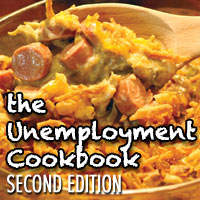
- Being frugal can allow for creativity. It can be simple home decor, clothing options, or cooking a meal. Saving pennies can mean celebrating the lean times. Sure, it’s corny like a country song, but trust me. It works. It’s what led me to write and publish The Unemployment Cookbook. That’s a sweet success in my book!
One of the first things you can do when the money situation gets you down, is tell yourself it’s okay. It’s okay to know it’s there, but it’s also okay to say “I won’t let my lack of money define me.” It’s okay to choose to breathe.
Have dialogue with yourself and your family. Ask the hard questions:
- Is this necessary, or a just a social “requirement”?
- Is there a cheaper alternative?
- If not, what else can we do to afford this?
Then it’s time to be honest with the creditors:
- Explain your situation and be honest about how you got there.
- Ask for repayment options. If you can’t pay their “minimum” do they have an extended payment plan?
- Can they give you a reduced pay-off balance?
- If you absolutely can’t pay, be honest. Don’t commit to a payment you can’t make. And don’t get angry at them about it. Those calls you’re getting? They’re just doing their job.
Then stop. Take another breath. And tell yourself, “It’s going to be okay.” Even if you don’t know how. Trust that it will work out. You can be strict without being overbearing. You can be in a financial struggle and still enjoy your day-to-day life.

Choose Your Direction: Stress or Relax
It’s okay to drink of cup of hot (or sweet) tea. It’s okay to buy clothes at the thrift store and make them your own. It’s okay to walk somewhere, or buy a $0.99 box of mac-n-cheese instead of a $7.00 combo meal.
You have a choice. Even when the money situation isn’t getting any better, you have the choice to not let it define you.
Remember, it’s just a situation. It’s not a lifestyle.
Embrace the happy and you’ll see how rich you truly are.
And Frankly, My Dear . . . That’s all she wrote!
Apr 19, 2012
Recently, I was asked what my writing style is. That’s a loaded question! Because it’s not just one question. Those four seemingly innocuous words, “What’s your writing style?” mean so much more than that. More often than not, they’re asked by someone who is trying to find their own style, a new writer who may think there’s a right and wrong way to write.
Asking, “What’s your writing style?” more often than not means, “I’ve heard this and read that. I’m having trouble formulating my thoughts and my story isn’t flowing as well as I’d like. I’m looking for ideas. Can you inspire me?”
People often tell me that I’m gifted with words, and they wish they could be writers. It’s my belief that everyone can be a writer. I agree for some it can be hard, difficult, to see things in a Wordy Way, but it’s not impossible.
So I’d like to devote this post to a few tips to help people get over their writer’s block and inhibitions.
Most people don’t believe they can write, but they can certainly tell stories! I suggest recording yourself when you’re talking with friends. Write a journal. Look for the details in everything you see. Practice.
Don’t worry about grammar and spelling, punctuation and structure. That’s not writing. That’s editing. Don’t confuse the two! Editing in the polish after the fact. Writing is getting it on paper.
Of course, you’re expected to have at least a working vocabulary and basic writing skills. But very rarely is a person a professional writer and editor.
I keep a memo board in my bedroom that I write on to track my progress, list potential ideas, and set deadlines. It’s my “Dream Board”, meaning, if I could accomplish all those things I’d be in Heaven but I know it’s not possible. DO NOT EXPECT YOURSELF TO BE PERFECT.
I always recommend that you write the way you talk. This works great for texting, journaling, and blogging. But what if you have a story to tell that’s set in Victorian England or, say, Middle Earth? I doubt very much they would say, “Pass the remote, I wanna change the channel.”
But it’s a start. If you’re having trouble starting, forget all the details. Forget the structure, the voice, the lingo. Just write out a draft in your own words. After you get the basic idea on paper, you can go back later and fine-tune it, turn the channel changing into a cup of tea in the garden.
If you’re experiencing writer’s block after a few pages, try to change your outlook. Let’s say you’ve got ten pages down and the narrative is from a first-person perspective. And now you’re stuck and don’t know what to do? Change the character! I’m not saying go back and rewrite what you have. But for the next few pages, draft some lines from another character’s point of view. Then go back and figure out how your original character would react.
Some people recommend a detailed outline. Knowing the in’s and out’s, the beginning, middle and end before you actually write it out, can obviously be very helpful. That’s not how I write. Of course I have a basic idea of my storyline; otherwise I don’t really have a story. But I don’t write a complete outline. I keep notes and post-its when I’m writing. Notes can help you keep track of characteristics, lands, personalities, even made-up words you want to use. Sticky notes are great for story-boarding: putting your scenes in order. I like to let the scene write itself and edit it later.
Let’s say I’m writing a book about a bird building a nest. So I start with the bird finding twigs and such. But I get a thought about how the bird eggs will fit (or not) after it’s built. So I make note to revisit that section later. Then I continue writing how the bird collects materials. When I get that one section done; it’s okay to let my wander and play around so then I go to the eggs rolling around and maybe one falling out and being rescued (or not).
Then I put the two scenes together and see how they read. Maybe I need to expound more of the nest size. Maybe I spent too much time on the eggs and not enough on the building. That’s where the editing comes in. WORD OF WARNING: DON’T SPEND YOUR LIFE EDITING. IT WILL NEVER BE YOUR KIND OF PERFECT!
Once your characters develop in your head, you’ll find they take on a life of their own. That Pirate you created two chapters ago will in no uncertain terms tell you he can’t possibly be found knitting a scarf for his grandmother. He’d rather steal it! Are you writing about animals? Have you ever heard a cat moo or a mouse roar? Perhaps you want them to. If that’s your story, they’ll let you. But if not, they won’t. LET YOUR CHARACTERS BE THEMSELVES!
You’ll also find that each character strives for your attention. You’ll be writing about Pirate Jones when the scarf-knitter’s stable boy decides to come into your head. That’s when your notebook comes in handy. Jot down notes and ideas to placate the character creation, and get back to finishing the Pirate’s task. Trust me. In a few minutes, hours, or even days, Stable Boy will still be waiting for you.
When I’m seriously fighting writer’s block with a project I have to make progress on, I throw the linear writing out the window. Chapters 1 through 4 done, and it’s time for Chapter 5? Too bad! I gotta get the second scene of Chapter 17 out of my head first. Sometimes it’s beneficial to take a detour. Writing out a scene that takes place further on in your story can actually help you connect the dots in between.
I often fight against logic when I’m writing fantasy works. Gravity is a given on earth, but not necessarily Middle Earth. High Tea can be an elegant affair, but not quite so if elephants and sloths are in attendance. There are many, many times when I have to make the story do what I want it to, and not try to make sense out of it. In the end, if it reads well and runs together smoothly, you’ll know you did it right. And in the end, you’ll often find that little things you didn’t realize connected, do. When you wrote about the red pen in Chapter Two, you had no idea it would be the magic element that brought Great Aunt Edna’s horse home with saddle bags full of blank pages. But deep inside, your brain knew. And your brain will work with you to connect those dots, and so much more.
Still having trouble? Take a break. Get up. Walk around the yard. Listen to music. Talk to your family, your pets, your plants. Watch a TV show for half an hour. Get refreshed before you return to your work.
If what you’re writing isn’t fiction (essays, biographies, reference manuals), research! Go online. Visit the library. Watch news reports. Make notes of everything, and most importantly verify your sources!
I also highly recommend that you read. Read every day. Read what you want to write. Read the newspaper. Read poetry. Read a recipe. Imagine your characters in the same environment. How would they react? Would a Pirate really visit Middle Earth? Maybe not, but if you wrote 500 words about it, you’ll get some comic relief while still keeping your writing going.
And that is most important of all. Write. Every day. Those of you who have been around me long enough know the stories of how I met Stephen J. Cannell. His advice is exceptional. Click here to read that post, and I urge you to watch the video.
Finally, THIRD MOST IMPORTANT: DON’T JUST “SAVE” YOUR WORK – MAKE A BACKUP COPY!!! If your computer crashes, you’re screwed. If you write longhand, make a photo copy. Or put your notes in a very secure fireproof safe. No joke.
AND DON’T SHARE YOUR WRITINGS WITH JUST ANYONE UNLESS YOU CAN REALLY TRUST THEM. There’s too many word thieves out there!!!
Everyone has a story to tell. Everyone. You shouldn’t be afraid to tell yours.
And Frankly, My Dear… that’s all she wrote!